
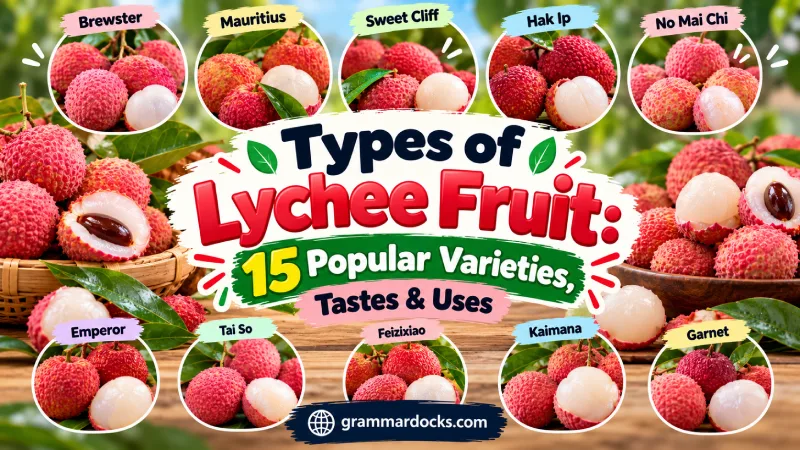
There are many types of lychee fruit, but most are cultivated varieties of the same species, Litchi chinensis. Popular varieties include Mauritius, Brewster, Sweetheart, Emperor, Hak Ip, Kaimana, Bengal, No Mai Tsz, and Fei Zi Xiao. They differ in fruit size, sweetness, aroma, rind color, seed size, texture, and harvest season. Ask IFAS – Powered by EDIS
Key Takeaways
- Lychee varieties are usually called cultivars, not separate fruit species.
- Mauritius and Brewster are two important varieties associated with U.S. production, especially Florida. UF IFAS Blogs
- Sweetheart is known for large, sweet fruit and relatively small seeds.
- Emperor stands out for its large fruit size.
- Hak Ip is valued for strong flavor, attractive color, and good-quality flesh.
- No Mai Tsz, also called Nuomici, is famous for its fragrance and tendency to produce small seeds.
- One lychee variety may have several names because cultivar names have been translated or transliterated differently across countries.
What Are the Different Types of Lychee Fruit?
Lychee is a tropical to subtropical fruit in the soapberry family, Sapindaceae. Its scientific name is Litchi chinensis. Longan and rambutan belong to the same botanical family but are different fruits. Ask IFAS – Powered by EDIS
Hundreds of named lychee selections have been recorded around the world. Different cultivars are important in China, India, Australia, Thailand, Bangladesh, South Africa, Hawaii, and Florida. For example, research references list Mauritius and Brewster in Florida, numerous regional cultivars in India, and many early-, mid-, and late-season types in China. PMC
What changes from one cultivar to another?
- Fruit size
- Rind color
- Shape
- Skin texture
- Seed size
- Amount of edible flesh
- Sweetness
- Floral aroma
- Juiciness
- Harvest timing
- Tree-growing characteristics
Those differences explain why two fresh lychees can look similar on the outside yet taste noticeably different.
15 Popular Types of Lychee Fruit at a Glance
| Lychee Variety | Known For | General Flavor | Fruit Size |
|---|---|---|---|
| Mauritius | Commercial importance and reliable production | Sweet, mildly tart | Medium |
| Brewster | Strong flavor and attractive red fruit | Sweet, aromatic | Medium |
| Sweetheart | Small seed and generous flesh | Very sweet, floral | Large |
| Emperor | Impressive fruit size | Sweet, mild | Large to very large |
| Hak Ip | Strong aroma and good flesh quality | Sweet, rich | Medium |
| Kaimana | Hawaiian selection and excellent fruit quality | Sweet, pleasant | Medium to large |
| Bengal | Large fruit and juicy flesh | Sweet, lightly tangy | Medium to large |
| Bosworth 3 | Later-season fruit | Sweet, aromatic | Small |
| Groff | Small seeds and later maturity | Sweet, aromatic | Small |
| No Mai Tsz | Small seed and prized fragrance | Very sweet, floral | Medium |
| Fei Zi Xiao | Famous Chinese cultivar | Sweet, fragrant | Medium to large |
| Shahi | Important Indian cultivar | Rich, sweet | Medium to large |
| Rose Scented | Distinctive aroma | Sweet, floral | Medium |
| China | Popular South Asian cultivar | Sweet, juicy | Medium to large |
| Bombai | Widely grown in Bangladesh | Sweet, juicy | Medium |
Fruit characteristics can change somewhat with climate, crop load, maturity, and growing conditions, so the table is best used as a general comparison rather than a rigid identification key. Horticultural references note that rind surface features can sometimes be more useful for cultivar identification than size or taste alone. ScienceDirect
1. Mauritius Lychee
Mauritius is one of the best-known commercial lychee varieties and is especially important in Florida. It may also appear under names such as Tai So or similar transliterations in international cultivar references. Growables
The fruit generally has a reddish, rough rind surrounding translucent white flesh. Its flavor is sweet but can retain a pleasant touch of acidity, especially compared with intensely sweet cultivars.
Mauritius is a practical choice for fresh eating because its flavor is easy to enjoy and its flesh is usually fairly firm.
Best for: Fresh eating, fruit salads, drinks, sorbets, and desserts.
2. Brewster Lychee
Brewster is another major lychee cultivar associated with Florida and U.S. production. UF/IFAS lists it among the good lychee varieties for Florida landscapes. UF IFAS Blogs
Brewster fruit usually develops an attractive pink-to-red skin and has juicy white flesh. UF/IFAS describes its flavor quality highly in its Florida cultivar comparison. Ask IFAS – Powered by EDIS
Brewster can have a larger seed than some premium small-seeded cultivars, so the amount of edible flesh may vary from fruit to fruit.
Best for: Eating fresh, juices, chilled desserts, and lychee-based drinks.
3. Sweetheart Lychee
Sweetheart is prized for large fruit, sweet flavor, and relatively small seeds.
Scientific sensory research on Sweetheart lychee found strong floral, tropical fruit, peach/apricot, and honey-like characteristics, with sweetness particularly prominent. PubMed
That combination makes Sweetheart especially attractive for people who want plenty of edible flesh without a large seed taking up the center.
Its pronounced aroma also makes it an excellent fresh-eating cultivar.
Best for: Fresh eating, premium fruit plates, sorbet, fruit salads, and desserts where lychee is the main flavor.
4. Emperor Lychee
Emperor is best known for its unusually large fruit.
UF/IFAS classifies Emperor fruit as medium to large among selected Florida cultivars and recommends it for home-growing situations. Ask IFAS – Powered by EDIS
Its size is one reason Emperor receives so much attention from home gardeners and specialty fruit enthusiasts. The flesh is juicy and sweet, while the large overall fruit makes peeling and serving easy.
It is especially appealing when appearance matters, such as on a tropical fruit platter.
Best for: Fresh eating, decorative fruit trays, desserts, and entertaining.
5. Hak Ip Lychee
Hak Ip is a highly regarded Chinese cultivar known for good flavor, attractive color, and quality flesh.
Its name may also appear as Haak Yip, Hei Ye, or Black Leaf. UF/IFAS recognizes these as names associated with Hak Ip. Ask IFAS – Powered by EDIS
Hak Ip usually produces reddish to purplish-red fruit with translucent white flesh. It is often appreciated for its combination of sweetness, aroma, and favorable flesh-to-seed ratio.
The name “Black Leaf” refers to the cultivar’s dark foliage rather than black fruit.
Best for: Fresh eating and desserts where a strong lychee flavor is desirable.
6. Kaimana Lychee
Kaimana is a Hawaiian lychee cultivar selected from seedlings of Hak Ip.
University of Hawaii researchers named Kaimana in 1982. The cultivar was selected for its fruit quality and relatively consistent production under Hawaiian conditions. Its fruit is described as deep maroon, oval, and roughly 20–26 grams in published extension information. CTAHR
Kaimana fruit contains a high proportion of edible pulp, although seed development can vary.
It has become one of the better-known Hawaiian lychees.
Best for: Fresh eating, fruit platters, tropical desserts, and juices.
7. Bengal Lychee
Bengal produces relatively large fruit with juicy, sweet flesh.
UF/IFAS lists Bengal, also associated with the name Rose Scented in its Florida cultivar table, among lychees evaluated under Florida conditions. Ask IFAS – Powered by EDIS
Cultivar naming can be confusing here because names may overlap across regions and horticultural records. For consumers, the important point is that Bengal is recognized as a genuine lychee cultivar rather than a separate species of fruit.
Its larger size makes it useful for serving fresh.
Best for: Fresh eating, fruit bowls, salads, and chilled desserts.
8. Bosworth 3 Lychee
Bosworth 3 is a smaller-fruited cultivar valued partly because it can extend the lychee season.
It is also associated with the name Kwai May Pink in UF/IFAS cultivar information. Ask IFAS – Powered by EDIS
Although the fruit is not as large as Emperor or some other premium selections, its eating quality can be very good.
Bosworth 3 demonstrates an important point about lychee: bigger does not automatically mean better. Aroma, seed size, texture, and sweetness can matter just as much as overall fruit size.
Best for: Fresh eating and home fruit collections.
9. Groff Lychee
Groff is a Hawaiian cultivar best known for its relatively small fruit, small seeds, and later harvest period.
Historical Hawaii cultivar information identifies Groff as a seedling derived from Hak Ip and highlights its small seeds and late maturity as desirable traits. Avocado Source
The smaller seed is important because it leaves more room for edible aril relative to the fruit’s total size.
Groff may not look as impressive as giant lychees, but it has useful characteristics for growers interested in extending the harvest season.
Best for: Fresh eating, syrups, desserts, and home orchards.
10. No Mai Tsz Lychee
No Mai Tsz is one of the most prized traditional Chinese lychee cultivars.
You may also see it spelled No Mai Chee, No Mai Tsze, Nuomici, or Nuo Mi Ci. The different spellings often reflect different systems for rendering Chinese cultivar names in English.
No Mai Tsz is especially valued for its fragrance and small-seed tendency. Scientific and horticultural references identify Nuomici among important Chinese lychee cultivars. PMC
The fruit typically has juicy, fragrant flesh that makes it particularly desirable for fresh eating.
Best for: Eating fresh with minimal preparation.
11. Fei Zi Xiao Lychee
Fei Zi Xiao is a famous Chinese lychee known for fragrance, sweetness, and early-season production in parts of China.
Its name may also be rendered Fay Zee Siu or in other slightly different English spellings.
Research references place Feizixiao among important Chinese lychee cultivars, particularly in the mid or relatively early portion of the production season depending on region. PMC
The fruit is generally juicy and aromatic, offering the floral character many people associate with high-quality fresh lychee.
Best for: Fresh eating, sorbet, granita, and light fruit desserts.
12. Shahi Lychee
Shahi is one of the important lychee cultivars grown in India, particularly in Bihar and surrounding production areas.
FAO references include Shahi among the major Indian lychee cultivars. FAOHome
The variety is valued for attractive fruit and sweet, juicy pulp. In areas where it is grown commercially, Shahi is often associated with premium fresh-market lychee.
Because international availability varies, American shoppers are less likely to see the cultivar name in a typical supermarket than Mauritius or Brewster.
Best for: Fresh eating and premium fruit displays.
13. Rose Scented Lychee
As its name suggests, Rose Scented lychee is known for an aromatic character that can remind people of roses or other floral notes.
The cultivar appears in Indian lychee records and is recognized in horticultural classifications. FAOHome
Its floral character illustrates why fresh lychee is difficult to describe simply as “sweet.” Aroma contributes greatly to how individual lychee cultivars taste.
Best for: Fresh eating, chilled fruit plates, and lightly flavored desserts that do not overpower its aroma.
14. China Lychee
China is the name of an important cultivar grown in parts of India and neighboring South Asian production regions.
FAO cultivar descriptions distinguish China from other Indian lychees by characteristics such as its pink fruit. FAOHome
It should not be confused with the general phrase “Chinese lychee.” In this context, China is a cultivar name.
The fruit is generally appreciated for sweet, juicy flesh.
Best for: Fresh eating, juices, fruit bowls, and desserts.
15. Bombai Lychee
Bombai is an important early lychee variety grown in Bangladesh and parts of South Asia.
FAO describes Bombai as a widely cultivated, productive Bangladeshi variety with heart-shaped, carmine-red fruit and soft, juicy, sweet pulp. FAOHome
It typically has a relatively large seed, so it may provide less flesh per fruit than premium small-seeded cultivars.
Its attractive shape and juicy texture still make it a popular fresh fruit.
Best for: Fresh eating, juices, fruit salads, and local fresh markets.
Which Type of Lychee Is the Sweetest?
There is no single universally sweetest lychee because sweetness changes with cultivar, climate, maturity, weather, and growing conditions.
However, Sweetheart, No Mai Tsz, Hak Ip, and several premium Chinese cultivars are commonly valued for strong sweetness and aroma. Sweetheart has also been studied scientifically for its sensory profile, with sweetness standing out strongly among measured attributes. PMC
A perfectly tree-ripened fruit of a good cultivar will usually taste sweeter and more aromatic than fruit harvested too early.
Which Lychee Has the Smallest Seed?
No Mai Tsz, Sweetheart, Groff, and some Hak Ip fruit are especially valued for small or partly aborted seeds.
A small seed is desirable because it means more space inside the fruit is occupied by edible flesh.
You may sometimes hear a small lychee seed called a “chicken tongue” seed. This describes a narrow, poorly developed seed rather than a completely seedless fruit.
Seed size can still vary within the same cultivar and from season to season.
Which Lychee Has the Largest Fruit?
Emperor is one of the best-known large-fruited lychee cultivars. Kaimana and several other varieties can also produce relatively large fruit.
Size alone should not determine which lychee is best. A slightly smaller cultivar with a tiny seed may provide as much or even more edible flesh than a larger fruit with a big seed.
For eating quality, consider:
- Fruit size
- Seed size
- Sweetness
- Aroma
- Texture
- Juiciness
What Lychee Varieties Are Common in the United States?
In the United States, Mauritius and Brewster are especially important in Florida, while varieties such as Sweetheart, Emperor, Hak Ip, and others are also grown or sold by specialty producers. UF/IFAS specifically identifies Mauritius, Brewster, Sweetheart, and Emperor as good varieties in Florida. UF IFAS Blogs
Hawaii has its own important cultivar history. Kaimana was developed there, while Hak Ip, Brewster, Groff, Tai So, and Bosworth 3 have also been grown in the state. Growables
Fresh lychee sold in a U.S. grocery store may not show a cultivar name on the package, so shoppers often simply see “lychee” or “litchi.”
How Can You Tell Lychee Varieties Apart?
You can sometimes narrow down a lychee cultivar by examining its shape, skin surface, color, fruit size, seed, and harvest timing, but visual identification is not always reliable.
Useful clues include:
- Fruit shape: Round, oval, egg-shaped, or heart-shaped
- Rind color: Pink, bright red, dark red, or reddish purple
- Skin texture: Fine bumps, broad bumps, or smoother areas
- Fruit size: Small to very large
- Seed: Large, medium, or narrow and partly aborted
- Flesh: Soft, crisp, firm, or very juicy
- Flavor: Mild, strongly sweet, floral, honey-like, or slightly tart
Horticultural references note that the shape and arrangement of the rind’s surface protuberances can be more dependable cultivar clues than flavor or fruit size alone. ScienceDirect
Even so, labeling from a reliable grower is usually the easiest way to know the exact cultivar.
Does Lychee Color Tell You the Variety?
Not reliably.
Many cultivars develop pink or red skin when mature, while individual fruits can change appearance depending on weather, sunlight, maturity, storage, and postharvest handling.
A dark-red fruit is not automatically Hak Ip, and a large red lychee is not automatically Emperor.
Color works best when combined with other clues such as shape, seed size, season, and known tree identity.
Fresh Lychee vs. Canned Lychee
Fresh and canned lychee can taste surprisingly different.
Fresh lychee usually has:
- Stronger floral aroma
- Firmer or more delicate texture depending on cultivar
- Natural sweetness
- More noticeable cultivar differences
Canned lychee is normally peeled, seeded, and packed in syrup. Processing and syrup can make the flavor more uniform, which means differences between cultivars become much harder to notice.
If you want to compare types of lychee fruit, fresh fruit is the better choice.
How to Choose Good Fresh Lychee
Choose lychees that feel plump and reasonably heavy for their size.
Look for:
- Intact skin
- No leaking juice
- No obvious mold
- Plump rather than badly shriveled fruit
- Fresh, pleasant aroma
- Firm but not rock-hard texture
Do not assume a brown rind automatically means the inside is spoiled. Lychee skin can lose its bright red color fairly quickly after harvest.
Once peeled, good flesh should be translucent white, juicy, and pleasantly scented rather than dry, brown, fermented, or sour-smelling.
Lychee vs. Rambutan vs. Longan
Lychee, rambutan, and longan are related members of the Sapindaceae family, but they are different fruits. Ask IFAS – Powered by EDIS
| Feature | Lychee | Rambutan | Longan |
|---|---|---|---|
| Outer skin | Rough, pink to red | Red or yellow with soft hair-like projections | Thin, tan to brown |
| Flesh | Translucent white | White to translucent | Translucent white |
| Flavor | Sweet, floral, lightly tart | Sweet, creamy to mild | Sweet, honeyed, sometimes musky |
| Size | Small to medium | Usually larger than longan | Small |
| Seed | One central seed | One central seed | One dark central seed |
If a fruit has long, soft “hairs” on the outside, it is rambutan rather than lychee.
Which Lychee Variety Is Best?
The best lychee depends on what you want from the fruit.
For large fruit, Emperor is an obvious choice. For high flesh-to-seed value, Sweetheart or a small-seeded No Mai Tsz can be appealing. For established U.S. cultivars, Mauritius and Brewster are important options. Hak Ip appeals to people who want rich flavor and aroma, while Kaimana is particularly notable in Hawaii.
There is no single cultivar that wins every category.
The best fresh lychee is ultimately one that is fully mature, juicy, fragrant, and recently harvested.
Frequently Asked Questions
How many types of lychee fruit are there?
There is no single simple number. Lychee-producing regions around the world maintain many named cultivars and local selections. The USDA’s tropical plant collection alone maintains numerous Litchi chinensis accessions, illustrating the fruit’s considerable cultivar diversity. ARS
Are all lychees the same fruit?
They belong primarily to the same species, Litchi chinensis, but cultivars can differ significantly in fruit size, flavor, aroma, seed size, color, harvest season, and tree performance.
What is the most common lychee in Florida?
Mauritius and Brewster have historically been particularly important Florida cultivars. UF/IFAS also recommends Sweetheart and Emperor among good varieties for Florida. UF IFAS Blogs
What is the difference between Mauritius and Brewster lychee?
Both are established lychee cultivars, but they differ in tree characteristics, skin appearance, fruit qualities, and seed development. Mauritius is especially valued for reliable production, while Brewster is known for attractive fruit and strong eating quality.
Are Mauritius and Tai So different lychees?
They are generally treated as the same or closely synonymous cultivar naming tradition in horticultural references. A University of Hawaii cultivar table lists Tai Tso with Mauritius as an alternate name. Growables
Is there a seedless lychee?
Some lychees develop very small, aborted seeds commonly described as “chicken tongue” seeds, and cultivars have also been selected for reduced seed size. However, a fruit marketed as seedless does not necessarily mean every fruit from the tree will contain no developed seed.
What does fresh lychee taste like?
Fresh lychee is generally sweet, juicy, floral, and lightly tart. The exact flavor depends on the cultivar. Studies of Sweetheart lychee, for example, identified prominent floral, tropical-fruit, peach/apricot, and honey-related sensory notes. PubMed
Which lychee is best for eating fresh?
Sweetheart, Hak Ip, No Mai Tsz, Brewster, Mauritius, Kaimana, and several Chinese and South Asian cultivars can all be excellent when properly ripened. Freshness and maturity often matter as much as the cultivar name.
Final Takeaway
The many types of lychee fruit are cultivated varieties of Litchi chinensis, each offering a slightly different combination of sweetness, aroma, texture, fruit size, rind appearance, and seed size.
For U.S. readers, Mauritius, Brewster, Sweetheart, Emperor, Hak Ip, and Kaimana are especially useful names to recognize. Around the world, cultivars such as No Mai Tsz, Fei Zi Xiao, Shahi, China, Bombai, and Rose Scented show just how diverse lychee can be.
If your goal is simply the best eating experience, look beyond size. A fresh, fully mature lychee with fragrant flesh and a small seed will usually give you the most satisfying bite.
[…] Some wild cactus species produce edible fruit, but you should not eat an unidentified wild cactus fruit simply because it resembles a known edible type. […]