
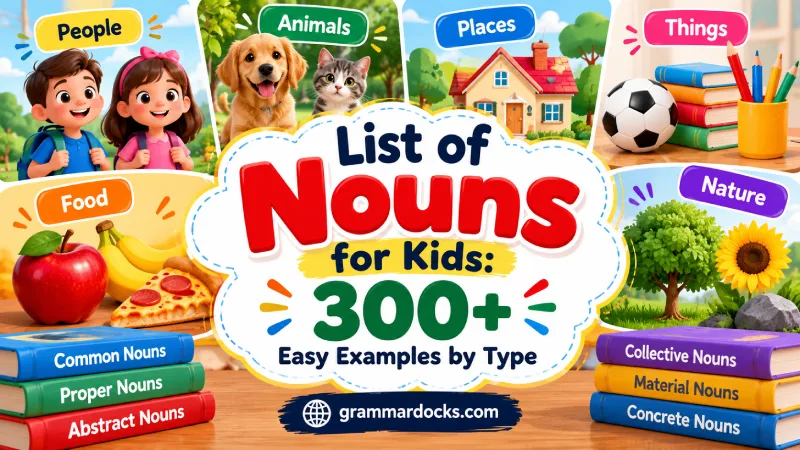
A noun is a word that names a person, place, animal, thing, event, feeling, quality, or idea. Easy examples include teacher, school, dog, pencil, birthday, happiness, and friendship. Nouns are often called “naming words” because they tell us who or what we are talking about.
This list of nouns for kids includes more than 300 simple words organized into useful groups. Kids can use the lists for homework, spelling practice, vocabulary building, sentence writing, classroom activities, or grammar lessons.
Key Takeaways
- A noun names a person, place, animal, thing, event, feeling, quality, or idea.
- Teacher, park, rabbit, book, and kindness are all nouns.
- Common nouns give general names, while proper nouns name specific people, places, or things.
- Proper nouns begin with capital letters.
- Nouns can also be concrete, abstract, collective, compound, countable, or uncountable.
- One noun can belong to more than one noun category.
Easy List of Nouns for Kids
Here are some simple noun examples children are likely to use every day:
boy, girl, teacher, student, mother, father, school, park, home, library, cat, dog, bird, fish, book, pencil, chair, table, apple, ball, car, tree, flower, friend, family, game, birthday, happiness, love, kindness
All of these words name someone or something.
300+ Nouns for Kids by Category
Grouping nouns makes them easier to learn. Start with familiar people, places, animals, and objects before introducing ideas and other less visible nouns.
Nouns for People
These nouns name people or roles.
- boy
- girl
- child
- baby
- mother
- father
- sister
- brother
- grandmother
- grandfather
- friend
- teacher
- student
- doctor
- nurse
- farmer
- driver
- artist
- singer
- writer
- firefighter
- baker
- chef
- neighbor
- coach
Example: The teacher helped the student.
Nouns for Places
These words name locations.
- school
- home
- park
- library
- classroom
- playground
- zoo
- farm
- garden
- beach
- store
- hospital
- kitchen
- bedroom
- city
- town
- village
- street
- restaurant
- museum
- airport
- station
- theater
- office
- forest
Example: We walked from the school to the park.
Animal Nouns for Kids
Animals are also nouns because their names identify living things.
- cat
- dog
- bird
- fish
- rabbit
- horse
- cow
- sheep
- goat
- chicken
- duck
- frog
- lion
- tiger
- elephant
- monkey
- bear
- deer
- fox
- turtle
- whale
- dolphin
- shark
- butterfly
- bee
Example: The rabbit watched a butterfly.
School and Classroom Nouns
These nouns are useful for young students because they name objects and people they see at school.
- book
- pencil
- pen
- eraser
- ruler
- notebook
- backpack
- desk
- chair
- board
- marker
- paper
- crayon
- scissors
- glue
- folder
- computer
- tablet
- bell
- clock
- lesson
- homework
- test
- question
- answer
Example: Mia placed her notebook and pencil on the desk.
Nouns Around the Home
- house
- door
- window
- room
- bed
- pillow
- blanket
- couch
- lamp
- television
- refrigerator
- oven
- sink
- plate
- bowl
- cup
- spoon
- fork
- towel
- mirror
- closet
- basket
- carpet
- toy
- picture
Example: The cat slept on the couch beside the lamp.
Food Nouns for Kids
- apple
- banana
- orange
- grape
- strawberry
- watermelon
- bread
- rice
- pasta
- cheese
- egg
- chicken
- sandwich
- pizza
- cereal
- soup
- salad
- cookie
- cake
- chocolate
- milk
- juice
- water
- carrot
- potato
Example: I ate an apple and a sandwich for lunch.
Nature Nouns
- sun
- moon
- star
- sky
- cloud
- rain
- snow
- wind
- river
- lake
- ocean
- mountain
- hill
- rock
- sand
- soil
- tree
- grass
- flower
- leaf
- forest
- island
- field
- rainbow
- storm
Example: Dark clouds covered the sky before the storm.
Transportation Nouns
- car
- bus
- truck
- train
- bicycle
- motorcycle
- airplane
- helicopter
- boat
- ship
- taxi
- van
- tractor
- scooter
- subway
- ambulance
- wagon
- skateboard
- canoe
- rocket
Example: The bus stopped near the station.
Body Part Nouns
- head
- hair
- face
- eye
- ear
- nose
- mouth
- tooth
- neck
- shoulder
- arm
- hand
- finger
- chest
- stomach
- leg
- knee
- foot
- toe
- heart
Example: Sam raised his hand.
Sports and Play Nouns
- ball
- bat
- glove
- team
- player
- coach
- game
- race
- goal
- field
- court
- playground
- puzzle
- doll
- kite
- block
- swing
- slide
- bicycle
- skateboard
Example: The player kicked the ball toward the goal.
Feelings, Qualities, and Idea Nouns
Some nouns name things we cannot pick up or touch.
- love
- happiness
- sadness
- anger
- fear
- excitement
- joy
- hope
- courage
- kindness
- honesty
- patience
- friendship
- peace
- freedom
- knowledge
- wisdom
- bravery
- trust
- pride
- respect
- curiosity
- imagination
- confidence
- fairness
Words such as happiness, honesty, and freedom are abstract nouns because they name qualities, feelings, or ideas rather than material objects.
Example: Her kindness brought everyone happiness.
Time and Event Nouns
- day
- night
- morning
- afternoon
- evening
- week
- month
- year
- birthday
- holiday
- vacation
- party
- meeting
- concert
- lesson
- game
- wedding
- lunch
- dinner
- recess
Example: My birthday is next month.
Community and Job Nouns
- police officer
- firefighter
- doctor
- nurse
- dentist
- teacher
- mechanic
- carpenter
- plumber
- electrician
- librarian
- cashier
- baker
- chef
- mail carrier
- pilot
- scientist
- veterinarian
- photographer
- musician
- engineer
- farmer
- barber
- painter
- judge
Example: The veterinarian examined the puppy.
What Is a Noun for Kids?
A noun is a naming word. It can name a person, place, animal, object, event, substance, feeling, quality, or idea.
For beginners, an easy way to remember nouns is:
| What the noun names | Examples |
|---|---|
| Person | teacher, child, doctor |
| Place | school, park, city |
| Animal | dog, rabbit, tiger |
| Thing | pencil, chair, ball |
| Event | birthday, game, party |
| Feeling | joy, fear, happiness |
| Quality | honesty, kindness, bravery |
| Idea | freedom, peace, knowledge |
A noun does not have to be something you can touch. Words such as courage and love are nouns even though they describe ideas or qualities. Purdue OWL likewise distinguishes physical nouns from abstract nouns such as integrity and love.
Main Types of Nouns for Kids
Children may meet several noun categories as their grammar skills develop.
The most useful types include:
- common nouns
- proper nouns
- concrete nouns
- abstract nouns
- collective nouns
- compound nouns
- countable nouns
- uncountable nouns
- singular nouns
- plural nouns
- possessive nouns
A noun can belong to several categories at the same time.
For example, apple is a common noun, concrete noun, countable noun, and singular noun.
Common Nouns for Kids
A common noun gives a general name rather than the name of one specific person, place, animal, or thing.
Examples include:
- boy
- teacher
- city
- school
- river
- dog
- bird
- book
- table
- flower
- game
- friend
- month
- store
- mountain
Common nouns normally begin with a lowercase letter unless they start a sentence.
Example:
The girl carried a book into the library.
Girl, book, and library are common nouns.
Proper Nouns for Kids
A proper noun names a specific person, place, day, month, organization, or other particular entity. Proper nouns use capital letters.
Examples:
- Emma
- Noah
- Olivia
- James
- California
- Texas
- Chicago
- Boston
- Monday
- Friday
- January
- October
- Pacific Ocean
- Central Park
- Mount Rushmore
Compare:
| Common noun | Proper noun |
|---|---|
| girl | Emma |
| boy | Noah |
| city | Chicago |
| state | California |
| day | Monday |
| month | January |
| park | Central Park |
Example:
We visited Chicago on Monday.
Both Chicago and Monday are proper nouns, so they begin with capital letters.
Concrete Nouns for Kids
A concrete noun names something physical or something that can be experienced through the senses.
Examples:
- apple
- chair
- dog
- bell
- rain
- cookie
- perfume
- music
- flower
- pencil
- carpet
- thunder
- ice
- bread
- sand
Notice that something does not always need to be touchable to fit a sensory category. For example, you can hear thunder or music and smell perfume.
Abstract Nouns for Kids
An abstract noun names an idea, feeling, state, or quality rather than a material object.
Examples:
- love
- joy
- fear
- courage
- kindness
- happiness
- sadness
- honesty
- patience
- freedom
- peace
- friendship
- knowledge
- confidence
- bravery
Example:
The firefighter showed great courage.
Courage is a noun even though it cannot be picked up or touched.
Collective Nouns for Kids
A collective noun names a group of people, animals, or things as a unit.
Examples:
- team
- family
- class
- crowd
- audience
- herd
- flock
- pack
- school
- swarm
- colony
- bunch
- bouquet
- crew
- choir
Examples in phrases:
- a team of players
- a flock of birds
- a herd of elephants
- a school of fish
- a swarm of bees
- a pack of wolves
- a bouquet of flowers
In standard American English, a collective noun is commonly treated as singular when the group is acting as one unit.
Example:
The team is practicing today.
Compound Nouns for Kids
A compound noun contains two or more words that work together as one noun. Compound nouns may appear as one word, separate words, or hyphenated words.
Examples:
One-Word Compound Nouns
- classroom
- toothbrush
- basketball
- bedroom
- sunlight
- notebook
- playground
- raincoat
- cupcake
- football
Open Compound Nouns
- bus stop
- ice cream
- post office
- dining room
- swimming pool
- fire truck
- school bus
- living room
- traffic light
- movie theater
Hyphenated Compound Nouns
- mother-in-law
- sister-in-law
- runner-up
- merry-go-round
Because compound spellings vary, children should learn the accepted spelling of each word rather than assuming every compound follows one rule.
Countable Nouns for Kids
Countable nouns name things that English treats as separate items that can be counted. They may normally have singular and plural forms.
Examples:
- one apple → three apples
- one book → five books
- one chair → six chairs
- one dog → two dogs
- one pencil → ten pencils
- one teacher → four teachers
- one cookie → eight cookies
- one balloon → three balloons
- one box → two boxes
- one child → four children
You can use numbers directly with countable nouns.
Uncountable Nouns for Kids
Uncountable nouns, also called noncount nouns, name things English usually treats as a whole, mass, substance, or general concept rather than separate countable items.
Common examples include:
- water
- milk
- rice
- sugar
- salt
- air
- sand
- furniture
- information
- advice
- homework
- knowledge
- luck
- music
- traffic
Instead of saying three waters when talking about the substance itself, we usually count a container or unit:
- three glasses of water
- two bottles of milk
- four bowls of rice
Some nouns can be countable or uncountable depending on their meaning, so children will discover more exceptions as their English skills grow.
Singular and Plural Nouns
A singular noun names one person, place, animal, thing, or idea.
Examples:
- cat
- child
- pencil
- apple
- house
A plural noun usually names more than one.
Examples:
- cats
- children
- pencils
- apples
- houses
Easy Regular Plurals
For many English nouns, add -s:
- cat → cats
- dog → dogs
- book → books
- chair → chairs
Some nouns take -es:
- box → boxes
- bus → buses
- dish → dishes
Irregular Plural Nouns
Some plural nouns change differently:
- child → children
- man → men
- woman → women
- foot → feet
- tooth → teeth
- mouse → mice
These forms need to be learned individually.
Possessive Nouns
A possessive noun shows that something belongs to someone or something.
Examples:
- Mia’s book
- the dog’s bowl
- the teacher’s desk
- the girl’s bicycle
- the children’s toys
Apostrophes are important because they help show possession.
Noun Examples in Sentences
Seeing nouns inside complete sentences makes them easier to recognize.
1. The dog chased the ball.
Nouns: dog, ball
2. Emma carried her backpack to school.
Nouns: Emma, backpack, school
3. The teacher opened the book.
Nouns: teacher, book
4. The rabbit jumped through the garden.
Nouns: rabbit, garden
5. My family visited the beach.
Nouns: family, beach
6. Courage helped the child speak.
Nouns: courage, child
7. The class watched a butterfly.
Nouns: class, butterfly
8. Noah put an apple on the table.
Nouns: Noah, apple, table
9. Friendship can bring happiness.
Nouns: friendship, happiness
10. The firefighters drove the truck.
Nouns: firefighters, truck
How Can Kids Find Nouns in a Sentence?
Try this simple three-step method.
Step 1: Look for Names
Ask:
Does this word name someone or something?
Example:
The puppy carried a toy.
Puppy and toy name things, so they are nouns.
Step 2: Ask “Who?” or “What?”
In this sentence:
The teacher opened the door.
Who opened something?
Teacher
What did the teacher open?
Door
Both are nouns.
Step 3: Check for Ideas and Feelings
Not every noun is visible.
In:
Kindness builds friendship.
Both kindness and friendship are nouns because they name ideas or qualities.
Common Nouns vs. Proper Nouns
One of the most important noun skills for kids is knowing whether a name is general or specific.
| Common noun | Proper noun |
|---|---|
| girl | Sophia |
| boy | Ethan |
| city | Boston |
| country | Canada |
| month | March |
| day | Tuesday |
| river | Mississippi River |
| ocean | Atlantic Ocean |
Remember:
General name = common noun
Specific name = proper noun
Proper nouns are capitalized.
Nouns vs. Verbs
Kids sometimes confuse naming words with action words.
A noun names someone or something.
A verb usually tells what someone or something does or describes a state.
| Noun | Verb |
|---|---|
| runner | run |
| singer | sing |
| teacher | teach |
| writer | write |
| swimmer | swim |
Example:
The runner will run around the track.
Runner is a noun. Run is a verb.
Nouns vs. Adjectives
An adjective describes a noun.
Compare:
- happy = adjective
- happiness = noun
- kind = adjective
- kindness = noun
- brave = adjective
- bravery = noun
Example:
The kind student showed kindness.
Kind describes the student, while kindness names a quality.
Easy Noun Practice for Kids
Activity 1: Find the Nouns
Find the nouns in each sentence.
- The cat jumped onto the chair.
- Ava carried a pencil.
- The children played in the park.
- Kindness makes a difference.
- The teacher opened the classroom door.
Answers
- cat, chair
- Ava, pencil
- children, park
- kindness, difference
- teacher, classroom, door
Activity 2: Person, Place, Animal, or Thing?
Sort these nouns:
doctor, rabbit, school, ball, mother, zoo, tiger, pencil
Answers
| Group | Nouns |
|---|---|
| Person | doctor, mother |
| Place | school, zoo |
| Animal | rabbit, tiger |
| Thing | ball, pencil |
Activity 3: Common or Proper Noun?
Decide whether each word is a common noun or proper noun.
- city
- Seattle
- teacher
- Emma
- Monday
- river
- California
- month
Answers
- city — common noun
- Seattle — proper noun
- teacher — common noun
- Emma — proper noun
- Monday — proper noun
- river — common noun
- California — proper noun
- month — common noun
Activity 4: Concrete or Abstract?
Sort these words:
apple, courage, book, happiness, chair, friendship, flower, honesty
Concrete Nouns
- apple
- book
- chair
- flower
Abstract Nouns
- courage
- happiness
- friendship
- honesty
Fun Ways to Teach Nouns to Kids
Grammar practice does not always need a worksheet. Everyday objects can turn noun learning into a simple game.
Try a Noun Hunt
Ask a child to look around the room and name ten nouns.
They might find:
- chair
- table
- pencil
- window
- book
- backpack
- clock
- lamp
- door
- computer
Play a Noun Sorting Game
Write several words on cards.
Ask the child to sort them into:
- people
- places
- animals
- things
- ideas
Sorting noun examples into categories is a common teaching approach because it helps children see how different naming words relate to one another.
Make a Common and Proper Noun Challenge
Give the child a common noun and ask for a matching proper noun.
Examples:
- city → Chicago
- girl → Olivia
- state → Texas
- month → April
- day → Saturday
Build a Noun Story
Give a child five nouns:
dog, forest, map, treasure, friend
Ask the child to write a short story that uses all five words.
This practices grammar and creative writing at the same time.
Common Noun Mistakes Kids Should Avoid
Mistake 1: Capitalizing Every Noun
Incorrect:
The Dog chased the Ball.
Correct:
The dog chased the ball.
Dog and ball are common nouns, so they do not need capitals in the middle of a normal sentence.
Mistake 2: Forgetting Capitals for Proper Nouns
Incorrect:
We visited california in june.
Correct:
We visited California in June.
Proper nouns require capital letters.
Mistake 3: Thinking Every Noun Must Be Touchable
Incorrect idea:
Happiness cannot be a noun because I cannot touch it.
Correct idea:
Happiness is an abstract noun because it names a feeling or state.
Mistake 4: Confusing Adjectives With Nouns
In:
The happy child smiled.
Child is the noun.
Happy is an adjective describing the child.
Frequently Asked Questions
What are nouns for kids?
Nouns are naming words. They name people, places, animals, things, events, feelings, qualities, or ideas. Examples include teacher, school, dog, book, birthday, and kindness.
What are 10 examples of nouns for kids?
Ten easy noun examples are boy, girl, teacher, school, dog, cat, book, pencil, apple, and park.
What are 20 common nouns for kids?
Twenty common nouns are child, mother, father, teacher, friend, school, home, park, city, dog, cat, bird, book, pencil, chair, table, apple, ball, tree, and flower.
What are the main types of nouns kids learn?
Common noun types include common, proper, concrete, abstract, collective, compound, countable, uncountable, singular, plural, and possessive nouns. The exact categories children study can vary by grade and curriculum.
What is the difference between a common noun and a proper noun?
A common noun gives a general name, such as city or teacher. A proper noun names a specific person, place, or other named entity, such as Chicago or Ms. Johnson, and begins with a capital letter.
Is an animal a noun?
Yes. Animal names such as dog, horse, tiger, rabbit, and elephant are nouns because they name living things. A pet’s specific name, such as Buddy, can be a proper noun.
Is “school” a noun?
Yes. School is usually a common noun because it names a general place. A specific school name can be a proper noun and should be capitalized.
Can a noun be more than one type?
Yes. Many nouns fit several categories. For example, apple can be a common noun, concrete noun, countable noun, and singular noun at the same time.
Final Review
A noun is a word that names someone or something. Kids can begin by learning familiar nouns such as teacher, school, dog, pencil, apple, and park, then move on to categories such as proper, abstract, collective, and compound nouns.
The easiest rule to remember is:
If a word names a person, place, animal, thing, event, feeling, quality, or idea, it may be a noun.
Learning nouns becomes much easier when children see them in real sentences, sort them into groups, and practice using the words in their own writing.

[…] is no single collective noun for every type of animal. Common choices include herd, flock, pack, school, swarm, colony, troop, pride, and pod, […]