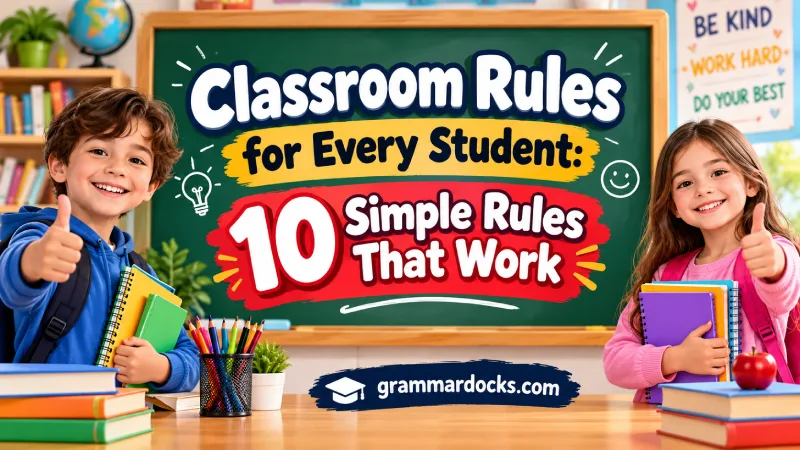
Good classroom rules help students understand how to learn, work, and interact respectfully. The best classroom rules for every student are simple, positive, and easy to remember. They should promote respect, safety, responsibility, preparation, and participation without turning the classroom into a long list of restrictions.
A teacher may use all 10 rules below or combine them into a smaller set of core expectations that fits the grade level and school.
Key Takeaways
- Treat teachers, classmates, and school property with respect.
- Arrive prepared, on time, and ready to learn.
- Listen when someone else is speaking.
- Follow directions and classroom procedures.
- Keep yourself and others physically and emotionally safe.
- Take responsibility for your learning, choices, and behavior.
10 Classroom Rules for Every Student
Classroom rules should tell students what successful behavior looks like. Clear wording is especially important because broad instructions such as “behave yourself” can mean different things to different students.
Here are 10 practical rules that work across many classroom settings.
1. Treat Everyone With Respect
Respect is one of the most important classroom expectations.
Students should speak politely, listen to different opinions, avoid insults, and respect personal space. The same standard should apply to interactions with classmates, teachers, substitutes, and other school staff.
Respect does not mean students must agree with everyone. They can disagree, ask questions, or challenge an idea while still communicating appropriately.
What it looks like:
- using kind and appropriate language
- listening without mocking others
- respecting personal boundaries
- disagreeing without attacking someone
- treating everyone fairly
A respectful classroom gives students more confidence to participate and share their ideas.
2. Arrive on Time and Be Ready to Learn
Students should enter class with the materials and mindset they need to begin.
Depending on the grade and subject, this may include notebooks, pencils, books, completed assignments, charged devices, or other required supplies.
Being prepared also means getting started when class begins instead of waiting for repeated reminders.
What it looks like:
- arriving before class starts
- going to the correct seat or work area
- having necessary materials ready
- completing the opening activity
- checking instructions for the day
For younger children, teachers may need to teach and practice these steps as part of the morning or class-entry routine.
3. Listen When Someone Else Is Speaking
Students learn more effectively when everyone has a fair opportunity to speak and be heard.
When a teacher, classmate, guest, or presenter is speaking, other students should listen without unnecessary interruptions.
Active listening can include facing the speaker when appropriate, paying attention to the message, and waiting for the right time to respond.
This rule also teaches an important life skill: conversations work better when people listen as well as talk.
4. Follow Directions and Classroom Procedures
Students should follow reasonable classroom directions and learn the procedures used for everyday activities.
A rule and a procedure are not exactly the same.
| Classroom Rule | Classroom Procedure |
|---|---|
| Be respectful | How to participate in a discussion |
| Be prepared | What to do when entering class |
| Be responsible | How to turn in an assignment |
| Be safe | How to use classroom equipment |
| Listen carefully | What to do during instructions |
Rules provide broad boundaries for behavior. Procedures explain the specific steps students should follow during common activities.
Teachers should not assume students automatically know these routines. Showing and practicing them can make expectations much clearer.
5. Keep Hands, Feet, and Objects to Yourself
Physical safety should always be a basic classroom expectation.
Students should respect other people’s personal space and avoid hitting, pushing, kicking, grabbing, or throwing objects inappropriately.
For younger students, the familiar phrase “keep your hands and feet to yourself” may be easy to understand.
Older students may respond better to wording such as:
Respect other people’s personal space and physical boundaries.
The wording can change with age, but the purpose stays the same: everyone deserves to feel safe in the classroom.
6. Stay Focused and Use Class Time Wisely
Students should use learning time for learning.
That does not mean a classroom must always be silent. Discussions, group projects, experiments, games, and collaborative work can all be productive.
The important question is whether the activity supports the lesson.
Staying on task may mean:
- beginning work when instructed
- participating in group activities
- avoiding unrelated conversations
- completing assignments
- asking for help when confused
- returning attention to the task after a distraction
Teachers can make this expectation easier to follow by clearly explaining what students should be doing during each activity.
7. Take Turns and Use the Agreed Way to Speak
Students need a clear system for joining classroom conversations.
In some classrooms, that means raising a hand and waiting to be called on. In others, especially discussion-based classes, students may use a different turn-taking system.
The important rule is not necessarily “always raise your hand.”
A more flexible expectation is:
Use the classroom’s agreed way to ask questions, contribute ideas, or request help.
This allows teachers to adapt the rule for elementary classrooms, seminars, group discussions, labs, and other learning environments.
8. Take Care of Classroom Materials and Shared Spaces
Books, desks, technology, art supplies, science equipment, and other classroom resources should be handled responsibly.
Students should also help leave shared areas clean and ready for the next person.
What it looks like:
- returning materials to the proper place
- cleaning up after an activity
- using equipment correctly
- avoiding damage to books, furniture, and devices
- reporting broken or unsafe items
Caring for shared property teaches responsibility while making the classroom more pleasant for everyone.
9. Use Phones and Technology Only as Directed
Technology rules have become an important part of classroom management.
Phones, tablets, laptops, smartwatches, headphones, and other devices can support learning, but they can also create distractions when used at the wrong time.
Students should follow their teacher’s and school’s technology policies.
A simple classroom expectation might be:
Use technology for learning when you have permission to use it.
Teachers should be specific about what this means.
For example, students may need to know:
- when phones must be put away
- when laptops may be opened
- whether headphones are allowed
- which websites or apps may be used
- whether photos or recordings are permitted
- how devices should be stored during tests
Clear rules reduce arguments caused by students having different ideas about acceptable technology use.
10. Take Responsibility for Your Choices and Learning
Students will make mistakes. A strong classroom rule system should teach responsibility rather than expect perfection.
Taking responsibility means recognizing what happened, correcting the problem when possible, and making a better choice next time.
It also applies to academic work.
Responsible students learn to:
- ask questions when they are confused
- complete work honestly
- admit mistakes
- accept appropriate feedback
- make up missed work when required
- seek help before falling too far behind
- put reasonable effort into assignments
Responsibility helps students become more independent learners over time.
What Are the 5 Most Important Classroom Rules?
Teachers who want a shorter system can combine many specific behaviors into five broad classroom rules:
- Be respectful.
- Be responsible.
- Be ready to learn.
- Be safe.
- Do your best.
These five expectations can cover many everyday situations.
For example, “be respectful” can include listening when others speak, using kind language, and taking care of property. “Be responsible” can include completing work, following routines, and using technology appropriately.
Teachers can then teach specific procedures underneath each broad rule.
Why Are Classroom Rules Important?
Classroom rules create clear boundaries for how students are expected to behave and participate.
Without clear expectations, students may have to guess what a teacher considers appropriate. One teacher may allow quiet conversation during independent work, while another expects silence. One class may use hand-raising, while another uses open discussion.
Clear rules remove much of that uncertainty.
They can also support:
- physical and emotional safety
- respectful communication
- smoother classroom routines
- greater student independence
- productive learning time
- fairer and more consistent expectations
Rules are most useful when students understand not only what the rule says but also what it looks like during real classroom situations.
Classroom Rules vs. Expectations: What Is the Difference?
The terms are often used together, but they can describe slightly different things.
Classroom expectations are broad standards for how students should behave, such as being respectful, safe, or responsible.
Classroom rules turn those expectations into clearer behavioral boundaries.
Classroom procedures explain exactly how routine tasks should be completed.
For example:
Expectation: Be responsible.
Rule: Bring the materials you need to class.
Procedure: Enter the room, place homework in the collection tray, take your seat, and begin the warm-up activity.
Using all three makes classroom behavior easier for students to understand.
How Teachers Can Introduce Classroom Rules Effectively
Simply putting rules on a wall is usually not enough. Students need to understand what each expectation means in practice.
Keep the List Manageable
Avoid creating a separate rule for every possible problem.
Several specific behaviors can often fit under one broader expectation.
Instead of having separate rules for interrupting, name-calling, borrowing supplies, and touching another student’s belongings, many of these behaviors can be taught under “Be respectful.”
Use Positive Language
Whenever practical, explain what students should do rather than focusing only on what they should not do.
Instead of:
Don’t shout.
Try:
Use an appropriate voice for the activity.
Instead of:
Don’t leave trash everywhere.
Try:
Keep our classroom clean.
Positive wording gives students a behavior they can actually follow.
Explain the Reason Behind Each Rule
Students are more likely to understand an expectation when they know its purpose.
For example:
We listen when others speak because everyone deserves a chance to be heard.
That gives the rule more meaning than simply saying, “Because I said so.”
Model the Expected Behavior
Show students what a rule looks like.
A teacher can model how to enter the classroom, ask for help, move into groups, use materials, or clean up after an activity.
With younger students, practicing the correct behavior can be especially useful.
Let Students Contribute
Teachers still need to maintain important boundaries involving safety, learning, and school policy, but students can help define what classroom expectations look like in daily life.
For example, ask:
What does respect look like during a class discussion?
Students might suggest:
- let people finish speaking
- avoid making fun of answers
- respond to ideas rather than attacking people
- give classmates a chance to participate
This turns a broad word such as “respect” into visible behavior.
Review Rules Throughout the Year
Classroom expectations are not only a first-day-of-school activity.
Review them when:
- returning from a long break
- beginning a new semester
- introducing a new classroom activity
- routines are becoming inconsistent
- students need a reminder
A brief reset can be more useful than adding more rules.
Classroom Rules by Grade Level
The basic principles may stay similar, but the language should match students’ age and independence.
| Grade Level | Example Expectation |
|---|---|
| Preschool | Use kind words and gentle hands |
| Kindergarten | Listen when someone is talking |
| Elementary | Be respectful and ready to learn |
| Middle School | Respect people, property, and learning time |
| High School | Arrive prepared, participate appropriately, and take responsibility for your work |
Younger students usually benefit from short wording, visual reminders, modeling, and repeated practice.
Older students can handle broader expectations and more responsibility for managing their own behavior.
Simple Classroom Rules Poster
Teachers who want a short poster can use this version:
Our Classroom Rules
Be Respectful
Use kind words and respect people, ideas, and property.
Be Responsible
Make good choices and take ownership of your actions.
Be Ready
Arrive prepared and ready to learn.
Be Safe
Protect your own safety and the safety of others.
Be Your Best
Participate, keep trying, and ask for help when you need it.
Specific procedures can then be taught separately.
What Should Happen When a Student Breaks a Rule?
Responses should be clear, calm, fair, and consistent with school policy.
For minor problems, the first response may simply be a reminder or redirection.
A general progression might include:
- Remind the student of the expectation.
- Redirect the student toward the correct behavior.
- Give the student an opportunity to correct the behavior.
- Speak privately if the behavior continues.
- Apply an appropriate classroom or school consequence when necessary.
- Involve families, support staff, or administrators when the situation requires additional support.
Serious safety problems may require an immediate response rather than following every step in order.
Teachers should also consider individual student needs and any required school supports rather than assuming every situation should be handled identically.
Fairness means applying expectations consistently while responding appropriately to the situation.
Common Mistakes to Avoid With Classroom Rules
Even good rules become less useful when they are implemented poorly.
Creating Too Many Rules
Students are unlikely to remember a long list covering every possible situation.
Use broad expectations and teach specific procedures separately.
Using Vague Rules
“Be good” is difficult to measure because students may interpret it differently.
“Listen while another person is speaking” is much clearer.
Focusing Only on Prohibited Behavior
A wall filled with NO, DON’T, and NEVER statements tells students what to avoid but may not clearly explain the desired behavior.
Whenever possible, show them what success looks like.
Having Rules That the Teacher Rarely Enforces
An expectation loses meaning when it is enforced one day and ignored the next.
Choose rules that are realistic enough to support consistently.
Assuming Students Already Know the Rules
Students enter classrooms with different experiences, cultures, personalities, and previous school routines.
Teach the behavior you expect instead of assuming everyone interprets a rule in exactly the same way.
Frequently Asked Questions
What are good classroom rules for every student?
Good classroom rules include being respectful, arriving prepared, listening when others speak, following directions, staying safe, using learning time responsibly, caring for classroom property, and taking responsibility for your choices.
The wording should be adjusted for students’ age and the school’s expectations.
How many classroom rules should a teacher have?
A small number of broad rules is usually easier to teach and remember than a long list. Many classrooms can organize most behavior around three to five core expectations such as respect, responsibility, readiness, safety, and effort.
More specific instructions can be taught as classroom procedures.
What is the most important classroom rule?
Respect is one of the strongest starting points because it can apply to classmates, teachers, property, ideas, personal space, and learning time.
However, safety and responsibility are also essential. A successful classroom usually depends on several expectations working together.
Should students help create classroom rules?
Students can help discuss and define classroom expectations, particularly what broad ideas such as respect, responsibility, or cooperation look like in practice.
Teachers should still maintain necessary boundaries related to safety, school policies, academic requirements, and student rights.
What is the difference between a classroom rule and a procedure?
A rule describes expected behavior, while a procedure explains how to complete a specific routine.
“Be prepared” is a rule or expectation. “Take out your notebook and begin the warm-up after entering class” is a procedure.
How should classroom rules be taught?
Explain each rule in clear language, show examples, model the expected behavior, let students practice important routines, and provide reminders when necessary.
Rules become more useful when students know exactly what they look like during real classroom activities.
Should classroom rules be the same for every age group?
The main values can stay similar, but the wording and level of independence should change.
A kindergarten class may use “Use kind words and gentle hands,” while a high school class might use “Respect people, property, and the learning environment.”
What is a good classroom rule for cell phones?
A flexible rule is: Use phones and other devices only when permitted for the current activity.
Teachers should also explain exactly when devices must be stored, when they may be used, and how the classroom rule fits the school’s technology policy.
Final Thoughts
The best classroom rules for every student are not complicated. They create a clear foundation for respect, safety, responsibility, preparation, and learning.
Start with a few broad expectations, explain what they look like in real situations, teach important procedures, and apply the rules consistently. When students understand both the expectations and the reasons behind them, classroom rules become more than words on a poster—they become part of how the class works every day.