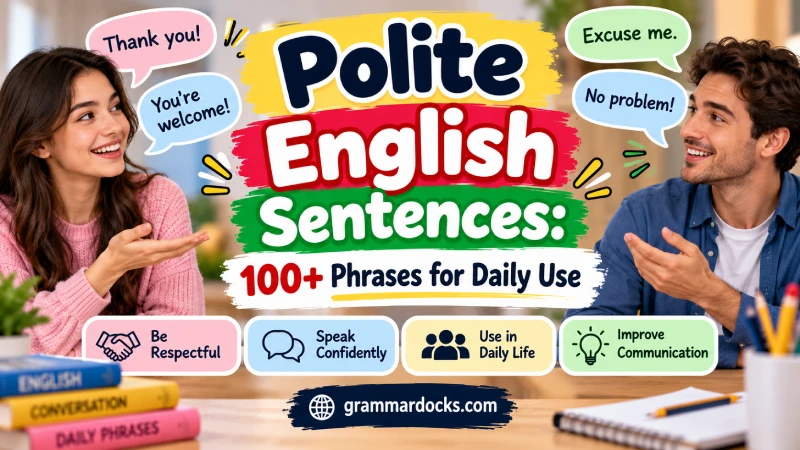
Polite English sentences help you speak respectfully without sounding too direct. Common patterns include “Could you…?” “Would you mind…?” “May I…?” “Excuse me…” “Thank you…” and “I’d appreciate it if…” The best phrase depends on the situation, your relationship with the listener, and how formal you need to be.
In English, polite communication is not only about adding please. Speakers often make requests less direct by using words such as could and would. May I…? is commonly used for more formal requests for permission.
Key Takeaways
- Use could and would to make requests sound softer.
- Use may I when asking permission in a formal situation.
- Use please, thank you, excuse me, and sorry naturally.
- Avoid direct commands when speaking to strangers, customers, teachers, or coworkers.
- Your tone and situation can affect politeness as much as the sentence itself.
- Learn complete sentence patterns instead of memorizing single polite words.
What Are Polite English Sentences?
Polite English sentences are expressions that show respect, consideration, friendliness, or professionalism.
Compare these two requests:
Direct: Give me a glass of water.
Polite: Could I have a glass of water, please?
Both communicate the same basic need, but the second sentence sounds less demanding.
English often uses indirect language for requests. Cambridge Grammar notes that requests are commonly made with forms such as can, could, and would you mind, while very direct forms such as I want may sound impolite in some situations.
Quick Guide to Polite English Sentence Patterns
| Purpose | Useful Pattern | Example |
|---|---|---|
| Ask someone to do something | Could you + verb…? | Could you help me, please? |
| Make a softer request | Would you + verb…? | Would you send me the details? |
| Ask permission | May I + verb…? | May I come in? |
| Ask permission naturally | Could I + verb…? | Could I sit here? |
| Ask very politely | Would you mind + -ing…? | Would you mind closing the door? |
| State what you want politely | I’d like + noun/to + verb | I’d like to speak with the manager. |
| Interrupt | Excuse me… | Excuse me, may I ask something? |
| Apologize | I’m sorry… | I’m sorry for the delay. |
| Show gratitude | Thank you for… | Thank you for your help. |
| Politely disagree | I see your point, but… | I see your point, but I have a different view. |
100 Polite English Sentences for Everyday Use
The following examples cover common situations at home, school, work, restaurants, stores, public places, and social gatherings.
1. Polite Greetings and Introductions
- Good morning. How are you?
- Good afternoon. It’s nice to see you.
- Good evening. How have you been?
- Hello, it’s a pleasure to meet you.
- Nice to meet you.
- How are you doing today?
- I hope you’re doing well.
- Please let me introduce myself.
- It was nice meeting you.
- Have a wonderful day.
These sentences are simple, but they create a friendly tone before you make a request or begin a longer conversation.
Polite Sentences for Asking for Help
- Could you help me, please?
- Could you give me a hand with this?
- Would you mind helping me for a moment?
- Could you explain this to me, please?
- Would you please show me how this works?
- Could you help me find this address?
- Would you be able to help me with this problem?
- Excuse me, could I ask for your help?
- Could you take a look at this for me?
- I’d really appreciate your help.
Could you…? is one of the safest patterns for polite everyday requests. British Council teaching materials describe could you and would you as polite request forms, while can you is generally more informal or direct.
Polite Sentences for Asking Permission
- May I come in?
- May I ask you a question?
- Could I sit here?
- Could I use your phone for a moment?
- May I borrow your pen?
- Would it be okay if I left a little early?
- Do you mind if I open the window?
- Would you mind if I joined you?
- Could I have a few minutes of your time?
- Is it okay if I call you later?
May I, Can I, or Could I?
All three forms can appear in permission questions, but they do not always have the same tone.
- Can I…? sounds normal and informal.
- Could I…? is softer and more polite.
- May I…? is more formal.
Cambridge Grammar describes may as a more formal permission form and could as more polite or formal than can in many permission questions.
Polite English Sentences for School and Class
- Excuse me, may I ask a question?
- Could you explain that again, please?
- Could you speak a little more slowly, please?
- May I borrow a pencil?
- Could you help me understand this question?
- Would you mind repeating the instructions?
- May I come in?
- Could I submit my assignment tomorrow?
- I’m sorry, I didn’t understand that part.
- Thank you for explaining it.
Students do not need extremely formal English for every classroom conversation. Short expressions such as “Could you explain that again?” are polite, clear, and natural.
Polite English Sentences for the Workplace
- Could you please send me the report?
- Would you be available for a quick meeting?
- Could we discuss this later today?
- Would you mind checking this document?
- I’d appreciate your feedback on this.
- Could you clarify what you mean?
- Would it be possible to move the meeting?
- I’m sorry, but I won’t be able to attend.
- Thank you for letting me know.
- I appreciate your time and help.
For an even more formal workplace request, you can say:
“I would appreciate it if you could send me the updated document.”
This is usually more appropriate for professional communication than a direct sentence such as:
“Send me the updated document.”
Polite Sentences at Restaurants and Stores
- Excuse me, could I see the menu, please?
- Could I get some water, please?
- I’d like a cup of coffee, please.
- Could I have the check, please?
- Could you tell me what you recommend?
- Excuse me, do you have this in another size?
- Could you help me find this item?
- Would it be possible to get this without cheese?
- No, thank you. I’m fine for now.
- Thank you. Everything was great.
In American English, “Could I get…?” is common when ordering. “Could I have…?” is another polite and widely useful option.
Using I’d like… instead of I want… can also make an order sound softer and more courteous. Cambridge Grammar identifies would like as a common polite way of stating what someone wants.
Polite English Sentences for Travel and Public Places
- Excuse me, could you tell me where the restroom is?
- Could you show me how to get to the station?
- Excuse me, is this seat taken?
- Would you mind moving your bag, please?
- Could you tell me when we arrive?
- Could you please take a photo for us?
- Excuse me, which way is the exit?
- Could you tell me where I can buy a ticket?
- I’m sorry, could you repeat that?
- Thank you for your help.
Starting with “Excuse me” is useful when approaching a stranger because it politely gets the person’s attention before the question.
Polite Sentences for Phone Calls and Online Communication
- Hello, may I speak with Sarah, please?
- Could you hold for a moment, please?
- May I ask who’s calling?
- Could you please repeat your name?
- I’m sorry, I didn’t catch that.
- Could you send me the information by email?
- Would you mind sending that again?
- Thank you for getting back to me.
- I appreciate your quick response.
- Please let me know when you have a moment.
Professional messages usually sound better when the request is clear rather than overly complicated.
For example:
Clear and polite:
“Could you send me the final version by Friday, please?”
This tells the reader exactly what you need while keeping the tone respectful.
Polite Sentences for Apologies and Interruptions
- Excuse me, may I say something?
- I’m sorry to interrupt.
- Excuse me for a moment.
- I’m sorry I’m late.
- I apologize for the misunderstanding.
- I’m sorry for the inconvenience.
- Please forgive me for the mistake.
- I didn’t mean to upset you.
- I’m sorry. That was my mistake.
- Thank you for your understanding.
Excuse Me vs. Sorry
Use excuse me mainly when you:
- want someone’s attention,
- need to interrupt,
- need to pass someone,
- or are about to cause a small inconvenience.
Use sorry when something has already happened and you want to apologize.
For example:
Excuse me, could you help me?
But:
I’m sorry I stepped on your foot.
Polite Ways to Disagree, Refuse, and End a Conversation
- I understand what you mean, but I see it differently.
- I see your point, but I’m not completely sure I agree.
- That’s an interesting idea. Could we consider another option?
- I’m sorry, but I won’t be able to make it.
- Thank you for asking, but I’ll have to decline.
- No, thank you. I’m fine.
- I appreciate the offer, but I can’t accept it.
- Thank you very much for your time.
- It was great talking with you.
- Have a nice day.
Politeness does not mean that you always have to agree. You can disagree or say no clearly while still respecting the other person.
20 Extra Polite English Sentences Worth Learning
Here are 20 more expressions that are useful in many situations:
- Please take your time.
- After you.
- That’s very kind of you.
- I really appreciate it.
- You’re very welcome.
- It’s my pleasure.
- No problem at all.
- Would you like some help?
- May I help you?
- Please feel free to ask.
- Would you like me to explain?
- Could you say that one more time?
- I’m afraid I don’t understand.
- Could you please speak more slowly?
- Would you mind waiting for a moment?
- I was wondering if you could help me.
- Is there any chance you could help?
- Please let me know what works for you.
- Thank you for your patience.
- I look forward to speaking with you again.
How Do You Make a Sentence More Polite?
A simple way to make English more polite is to turn a direct command into a request.
Compare:
| Too Direct in Many Situations | More Polite |
|---|---|
| Give me the menu. | Could I see the menu, please? |
| Help me. | Could you help me, please? |
| Repeat that. | Could you repeat that, please? |
| Move your bag. | Would you mind moving your bag? |
| Send the report. | Could you send the report, please? |
| I want coffee. | I’d like some coffee, please. |
| Tell me where it is. | Could you tell me where it is? |
| Wait here. | Would you mind waiting here for a moment? |
| I disagree. | I see your point, but I think differently. |
| No. | No, thank you. |
Direct language is not always wrong. Commands are normal in emergencies, instructions, warnings, and some close relationships. The situation determines whether a direct form sounds natural or rude. Cambridge Grammar similarly notes that imperatives can be acceptable in warnings, instructions, directions, and certain other contexts even though they can sound too direct in ordinary requests.
Can You or Could You: Which Is More Polite?
Could you generally sounds softer than can you when making a request.
Examples:
Can you help me?
Friendly and common, especially with people you know.
Could you help me?
Softer and useful with strangers, coworkers, customers, or in situations where you want to sound more respectful.
However, can you is not automatically rude. Context, tone, relationship, and the size of the request all matter.
How to Use “Would You Mind” Correctly
Use:
Would you mind + verb-ing
Examples:
- Would you mind closing the door?
- Would you mind waiting here?
- Would you mind speaking more slowly?
- Would you mind helping me?
Do not say:
Would you mind to close the door?
After would you mind when asking someone to perform an action, English normally uses the -ing form. Cambridge Grammar gives the same construction for polite requests.
For permission, you can also say:
Would you mind if I sat here?
This politely asks whether your action would bother the other person.
Does Adding “Please” Always Make a Sentence Polite?
No. Please helps, but the entire sentence and tone matter.
Compare:
Give me that, please.
and:
Could you pass that to me, please?
The second one is softer because the request itself is less direct.
Also, the position and stress of please can change how a request feels. Cambridge Grammar notes that please can appear at different points in a request, and some placements may sound stronger depending on delivery.
For learners, one of the safest patterns is:
Could you + base verb + please?
For example:
Could you open the window, please?
How to Politely Ask Someone to Repeat Something
Instead of simply saying “What?”, try:
- Sorry?
- Excuse me?
- Could you repeat that, please?
- Could you say that again, please?
- Sorry, I didn’t catch that.
- Could you speak a little more slowly?
- I’m sorry, could you repeat the last part?
These phrases are especially useful for English learners because they allow you to keep a conversation going without pretending that you understood something.
How to Politely Say No in English
You do not need to give a long explanation every time you refuse something.
Useful responses include:
- No, thank you.
- Thank you, but I’m fine.
- I’m sorry, but I can’t.
- I appreciate the offer, but I’ll have to pass.
- Thank you for inviting me, but I won’t be able to come.
- I’m afraid that won’t work for me.
- Unfortunately, I’m not available then.
- Could we choose another time instead?
A polite refusal usually works best when it combines a clear answer with appreciation, a brief apology, or an alternative when appropriate.
Common Mistakes With Polite English
Using “May You” for a Normal Request
Avoid:
May you help me?
Use:
Could you help me?
May I…? is commonly used when the speaker is asking permission to do something themselves. British Council guidance similarly distinguishes may I for permission from could you or would you when asking another person to act.
Putting “To” After Could
Incorrect:
Could you to help me?
Correct:
Could you help me?
Modal verbs such as can, could, and may are followed by the base form of the verb.
Using the Wrong Form After “Would You Mind”
Incorrect:
Would you mind open the door?
Correct:
Would you mind opening the door?
Thinking “Could” Always Means Past Time
In:
Could you help me?
Could is being used to soften a present request. It does not mean the request happened in the past.
Using Overly Formal English With Everyone
A sentence can be grammatically correct but sound unnatural if it is too formal for the situation.
For example, you probably do not need to tell your close friend:
“Would you be so kind as to provide me with a glass of water?”
A simple sentence is better:
“Could you get me some water, please?”
Casual, Polite, and Formal English Compared
| Situation | Casual | Polite | More Formal |
|---|---|---|---|
| Ask for help | Can you help me? | Could you help me, please? | Would you be able to assist me? |
| Ask permission | Can I sit here? | Could I sit here? | May I sit here? |
| Ask for information | Where is the office? | Could you tell me where the office is? | Would you be able to tell me where the office is? |
| Ask someone to wait | Wait a second. | Could you wait a moment, please? | Would you mind waiting for a moment? |
| Ask for an item | Can I get this? | Could I have this, please? | May I have this, please? |
You do not always need the most formal option. The goal is to choose language that fits the situation.
How to Practice Polite English Sentences
Start with a small group of sentence patterns instead of trying to memorize hundreds of unrelated phrases.
Practice these five first:
- Could you ___, please?
- Could I ___, please?
- Would you mind ___ing?
- Excuse me, could you ___?
- I’d like ___, please.
Then replace the blank with different actions.
For example:
Could you help me, please?
Could you wait a moment, please?
Could you repeat that, please?
Could you show me where it is, please?
This method helps you create new polite sentences instead of memorizing every possible situation separately.
Frequently Asked Questions
What are some common polite English sentences?
Common examples include “Could you help me, please?” “Excuse me, may I ask a question?” “Thank you for your help,” “I’m sorry for the inconvenience,” and “Would you mind waiting for a moment?” These expressions work in many everyday situations.
What are the most important polite words in English?
Some of the most useful polite words and expressions are please, thank you, excuse me, sorry, you’re welcome, could you, would you, and may I. Knowing how to use them in complete sentences is more useful than simply memorizing the words.
How can I ask for something politely in English?
Use a softer request such as “Could I have…?”, “Could you…?”, or “I’d like…, please.” For example, instead of saying “Give me some water,” say “Could I have some water, please?”
Is “could you” more polite than “can you”?
Generally, yes. Can you is common and conversational, while could you usually makes the request sound softer. Neither form is automatically rude or polite in every situation because tone and context also matter.
Is “may I” more polite than “can I”?
May I is more formal, especially when asking permission. Can I is extremely common in everyday conversation, while could I offers a useful middle ground when you want to sound polite without being overly formal.
How do I politely ask someone to repeat themselves?
Say “Could you repeat that, please?”, “Sorry, I didn’t catch that,” or “Could you say that again, please?” These sound more courteous than simply saying “What?”
How do I politely disagree with someone?
Begin by acknowledging the other person’s idea. You might say “I see your point, but I think there may be another option” or “I understand what you mean, but I see it differently.” This allows you to disagree clearly without sounding aggressive.
How can I sound polite without sounding too formal?
Use simple everyday patterns such as “Could you…?”, “Would you…?”, “Thanks,”, “Excuse me,” and “I’m sorry.” Avoid unnecessarily long or ceremonial expressions when a short, respectful sentence will do.
Final Takeaway
You do not need complicated vocabulary to speak politely in English. A few flexible patterns can handle most everyday conversations.
Start with “Could you…?”, “Could I…?”, “Would you mind…?”, “Excuse me…”, “I’d like…”, and “Thank you.”
Then pay attention to the situation. Use casual language with people you know, softer requests with strangers and coworkers, and more formal expressions when the setting calls for them.
With regular practice, these polite English sentences will begin to feel natural rather than memorized.